Can you replace a fashion photoshoot with AI for a campaign? | Mira Studio
Yes, for set, casting, and variations. Not yet for the exact drape of a fabric or a model under exclusive contract.
· Guide · 6 min · By Estée Jaillon, Mira Studio
Yes, AI can replace a fashion photoshoot for set, casting, travel, and variations. Not yet for the exact drape of a complex fabric or a model under exclusive contract. In between: hybrid formats—real product photography art-directed with AI—are gaining ground.
What AI already replaces
Set and location. No need to rent a studio, fly a crew to Marrakech, or close a boutique to shoot. AI generates coherent backgrounds—palace, desert, cobblestone alley—in hours. At Mira Studio, AI creative agency in Paris, we deliver complete campaigns without a single trip: Jacob & Co (Holiday 2025, 14-day production), Borsalino Parfums, Sporty & Rich × Juicy Couture.
Casting. Finding the model who embodies the brand, negotiating rights, managing exclusivity: AI short-circuits all of it. You define age, body type, attitude; the tool generates faces consistent across visuals. No image contract, no exclusivity clause, no retouching session to unify lighting.
Variations and formats. An AI fashion campaign can produce 20, 50, 100 variations—colorways, framing, image size—in days. A traditional shoot delivers one master per look and bills retouching per unit. AI reverses the equation: multiplication becomes fast and inexpensive.
Timeline. Day 0 briefing, day 7 delivery, revisions included. Jacob & Co: 14 days for a complete campaign, international variations included. A traditional shoot requires several weeks of pre-production, one day of shooting, one to two weeks of post-production.
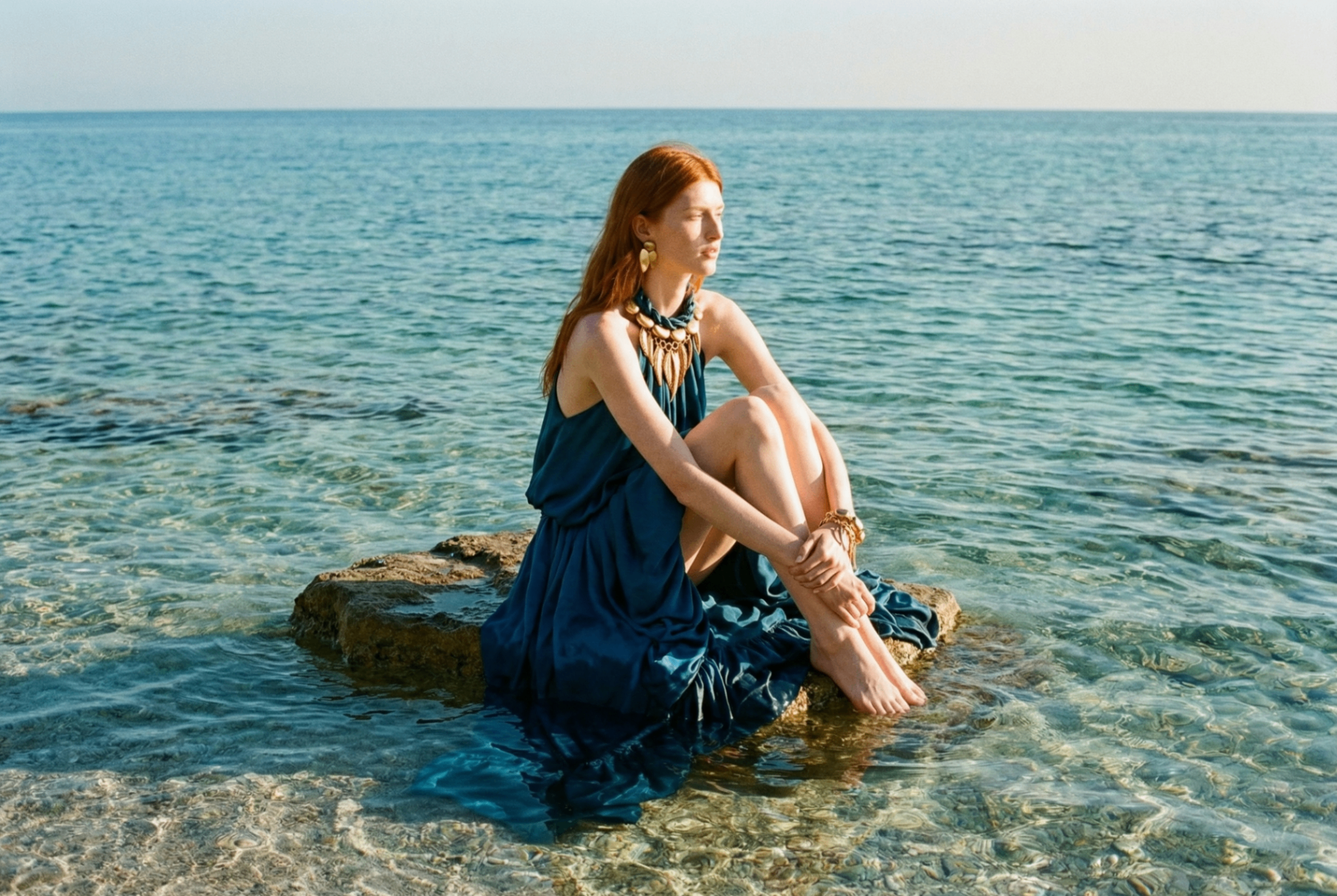
What AI doesn't replace yet
Exact fabric drape. Pleats, lace, tweed: AI generates a convincing visual impression but doesn't guarantee millimeter-precise drape fidelity. If your campaign aims to sell a specific product—a dress on pre-order, a limited-edition coat—and the customer expects a contractual representation, real photography remains the reference.
The contracted model. Some brands build their identity around a known face, paid for exclusivity. AI can't replace that contract or the celebrity value that comes with it. It can, however, produce complementary visuals (social, A/B testing, secondary markets) without mobilizing the model.
Certain house requirements. Total chain control (from lighting to RAW file), transparency clauses for shareholders, strict compliance with advertising standards in certain countries: some luxury houses still require a physical shoot for the campaign flagship, then supplement with AI for the rest.
The comparison table: traditional shoot vs AI fashion campaign
| Criterion | Traditional shoot | AI fashion campaign | Hybrid format |
|---|---|---|---|
| Set | Real location or studio | Generated | Real photo + AI set |
| Casting | Model under contract | Generated face | Real model + AI variations |
| Product | Photographed | Generated or inserted | Photographed then integrated |
| Average timeline | 3 to 6 weeks | 7 to 14 days | 10 to 20 days |
| Variations | Billed per unit | Included | Semi-automated |
| Fabric drape | Exact | Approximate | Exact (real product) |
| Image rights | Model contract | No third party | Model contract |
| Reuse | Limited (contract) | Unlimited (per AI license) | Per contract |
Hybrid formats: the best of both worlds
We photograph the product in studio—controlled lighting, faithful drape—then integrate it into an AI-generated set, on a generated or real model. Result: material fidelity + creative freedom. This is the format we use for brands that want product precision without the cost or timeline of a complete shoot. Velocity changes everything: when you deliver in one week instead of six, you can test three concepts instead of one.
Case in point: Jacob & Co. 14 days, generated sets, coherent faces, variations for each market. No travel, no international casting, no location rental. Art direction pilots everything from Paris.
Case in point: Borsalino Parfums and Borsalino (hats). Two campaigns, same values, distinct visual universes. AI allows brand identity to be declined without multiplying shoot days.
When to choose 100% AI, when to choose hybrid, when to keep traditional shooting
100% AI if:
- You don't have a physical product yet (pre-launch, concept test).
- You want to test several creative universes before committing a heavy budget.
- You need dozens of variations (formats, markets, languages).
- You're looking for velocity: campaign in 7 to 14 days.
Hybrid if:
- You're selling a specific product and want to show exact drape.
- You have a model under contract and want to multiply sets without mobilizing them.
- You want to combine brand image (known face) and flexibility (infinite variations).
Traditional shoot if:
- Your campaign relies on the celebrity of an exclusive model.
- Your legal counsel or shareholders require total transparency on the production chain.
- You want a RAW archive to guarantee traceability (strict advertising regulations, particularly in China and the UK).
What brands who took the leap say
We've produced 50+ campaigns for 20+ brands in Europe, the United States, and Asia: fashion (Sporty & Rich × Juicy Couture), beauty (Borsalino Parfums), jewelry (Jacob & Co, Chow Tai Fook in Hong Kong), publishers (Assouline, Voyage series). The common thread: they were looking for speed, flexibility, and the ability to test without committing six weeks of production.
None asked us to "copy" an existing shoot. They wanted a result that wouldn't have been possible otherwise—because too expensive, too long, or logistically impossible. That's the difference between replacing and inventing.
The legal framework: United States, Europe, Asia
United States. The FTC (Federal Trade Commission) requires that any advertising image faithfully reflects the product sold. If AI generates a different drape or color, you must mention it or correct it. No prohibition of AI, but the obligation not to deceive the consumer.
European Union. The regulation on unfair commercial practices (Directive 2005/29/EC) and the upcoming AI Act impose transparency on AI use in commercial content. Some brands add a "visual generated by AI" mention in footer, others choose to say nothing as long as the image is faithful to the product. The right reflex: check with your lawyer if your campaign falls under comparative advertising or distance selling.
China. The CAC (Cyberspace Administration of China) has required since 2023 explicit labeling of AI-generated content in certain contexts (news, deepfakes). For fashion advertising, the rule is unclear: seek advice from a local firm before broadcasting.
United Kingdom. The ASA (Advertising Standards Authority) applies the same principles as in Europe: no prohibition, but obligation of truthfulness. If the AI image distorts the product, it can be withdrawn.
In practice, most brands we work with choose internal transparency (brief, quote, approval) and external discretion, as long as the visual respects the product.
FAQ
Can you really replace a fashion photoshoot with AI for a luxury campaign?
Yes, if you're looking for set, casting, speed, and variations. Not yet if you're selling a specific product with complex drape or a model under exclusive contract. The hybrid format—real product + AI set—combines both.
How long does it take to produce an AI fashion campaign?
One week on average (day 0 briefing, day 7 delivery, revisions included). Jacob & Co was delivered in 14 days, international variations included. A traditional shoot requires three to six weeks.
Can AI reproduce the exact drape of a dress or fabric?
Not yet with the millimeter-precise fidelity required by an e-commerce product sheet. AI generates a convincing visual impression, but to sell a specific item, photograph it in studio then integrate it into a generated set. That's the hybrid format.