Beauty: producing 200 consistent e-commerce visuals with AI | Mira Studio
Master packshot, batch variations, light and colour control: the series method for delivering 200 consistent e-commerce visuals with AI.
· Method · 6 min · By Estée Jaillon, Mira Studio
A beauty brand launches a collection of 50 SKUs, each requiring four e-commerce visuals: white-background packshot, lifestyle ambiance, texture close-up, angle view. Total: 200 visuals. AI can produce this series in one week instead of three, provided you master visual consistency and avoid packaging pitfalls.
AI e-commerce visuals beauty: why the series approach changes everything
A traditional e-commerce shoot chains SKUs one by one: lighting setup, capture, retouching. With AI, we reverse the logic: we define a master packshot that sets the visual DNA—lighting, angle, contrast, depth of field—then we generate each SKU from that skeleton.
At Mira Studio, we've produced complete series for beauty and fragrance brands, with ranges from 20 to 60 SKUs. Typical timeline: D0 master packshot briefing, D2 first batch of variations, D5 colour and texture revisions, D7 delivery. The key: never treat visuals in isolation, always as a coherent series.
AI generates fast, but without method, each visual drifts imperceptibly: light temperature shifts, the angle pivots 2 degrees, depth of field adjusts. On a single visual, nothing shocking; across a grid of 200 visuals, the catalogue explodes.
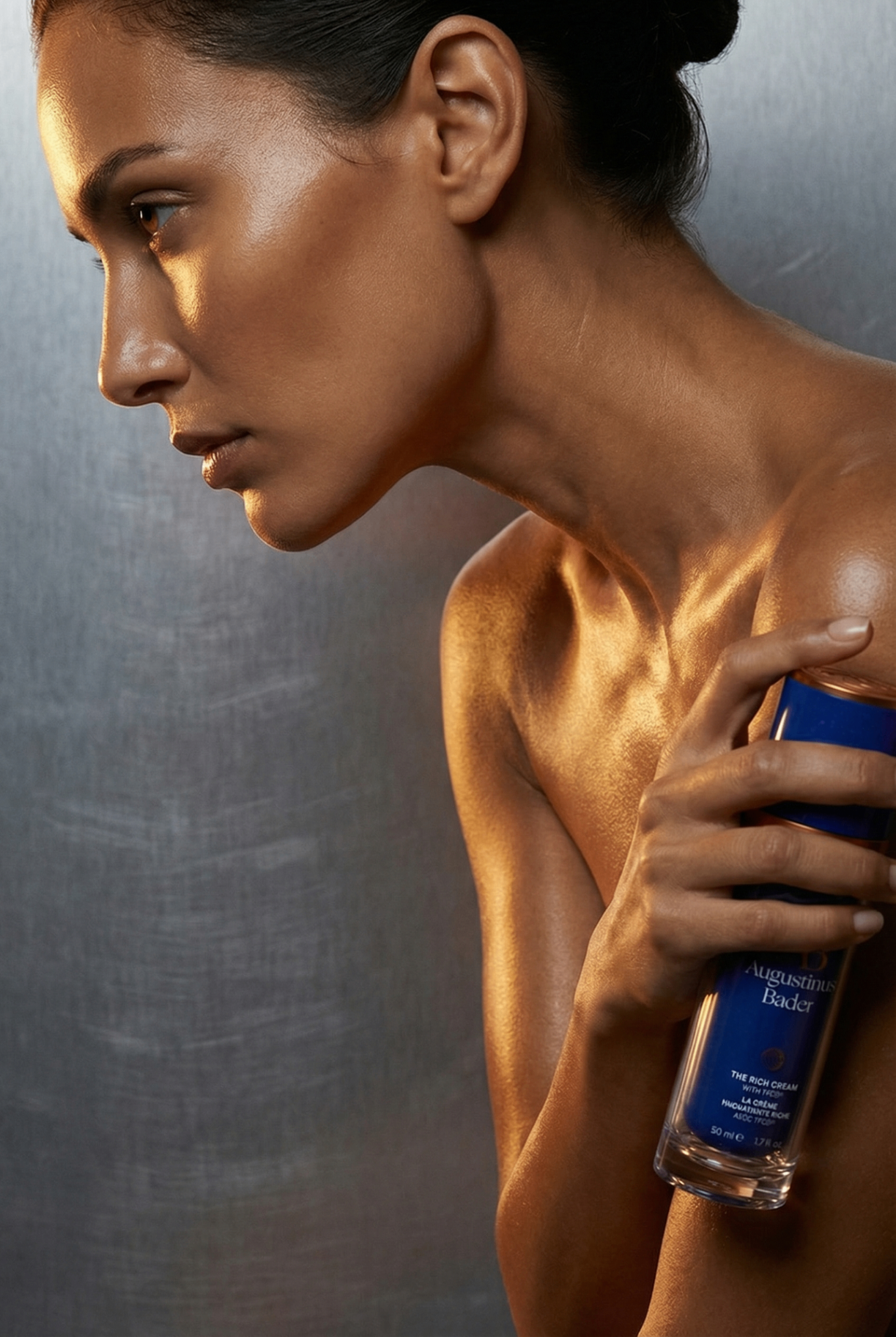
AI packshot cosmetics: building the visual skeleton
The master packshot is the first finalised visual, validated to the pixel. It sets:
- Lighting: direction, softness, Kelvin temperature. A seethrough effect (light through the bottle) can be driven in AI, but you must define it from the reference, otherwise some visuals will have it, others won't.
- Camera angle: 15° three-quarter front, eye level, slight downward tilt. We note the angle in degrees in the prompt and keep it strict across the entire series.
- Contrast and saturation: an emerald-green serum must stay emerald on white, grey or lifestyle backgrounds. Without a common colour reference, each variation drifts.
- Packaging detail: typography, hot foil stamping, embossed logo. The AI must understand the visual hierarchy: what stays sharp, what remains soft.
Once the master packshot is validated by the art director and the brand, we save it as a style reference. Each new variation will be generated by injecting this reference into the prompt, accompanied by the product photo or 3D render of the new bottle.
AI product photography beauty: 200-visual series in one week
Batch variation
We group SKUs by family: facial care, lip makeup, 30ml bottles, 50ml jars. Each family shares a common prompt structure; only the product reference changes.
Example: 20 serums, 4 visuals each. We first generate the 20 white-background packshots (batch 1), check lighting consistency, correct if needed, then move to the 20 lifestyle views (batch 2), then texture close-ups (batch 3), then angle views (batch 4). This wave approach prevents progressive drift and makes quality control easier.
Light and colour consistency control
After each batch, we display the full grid as a mosaic. We check:
- Light temperature: are all white backgrounds the same white, or do some pull blue, others cream?
- Highlight intensity: a glass bottle must reflect light the same way across the entire range.
- Hue saturation: a Kiss Red shouldn't shift to raspberry or brick from one visual to another.
If a visual drifts, we regenerate it by reinforcing the master reference in the prompt, or by adjusting the Kelvin temperature in post-production. The important thing: never validate a batch until the grid is homogeneous.
Naming and delivery
200 badly named visuals are unusable. We adopt a strict convention: Brand_Range_SKU_VisualType_Variant.jpg. Example: Brand_Serum_EmeraldGlow_Packshot_White.jpg, Brand_Serum_EmeraldGlow_Lifestyle_Marble.jpg.
We deliver in two formats: high resolution for print (3000 × 3000 px, 300 dpi) and web (1500 × 1500 px, 72 dpi, optimised). Each visual comes with a technical sheet: prompt used, master reference, colour adjustments. If the brand needs to reproduce a visual six months later, they have the exact recipe.
AI packshot cosmetics traps
Hues: the imperceptible drift
Generative AI reconstructs every pixel. A red #C41E3A can become #C72045 from one generation to the next. On a lipstick, that's a dealbreaker: the customer compares the e-commerce visual to the product received. The right reflex: extract the Pantone or RGB palette of each product, provide it as reference, and verify each visual with a colour-picker before validation. If the brand has a colour charter (Pantone swatches of packaging), ask for it from the brief.
Textures: glass, metal, cream
Glass is transparent and reflective; the AI must handle both the bottle's transparency and the environment's reflection. A badly generated bottle will be opaque or over-glossy. Same difficulty for metallic textures (aluminium caps, gold pumps) and creams (an open jar with visible creamy texture).
We work around the problem by providing real photo references of the empty packaging, taken from multiple angles and lighting conditions. The AI learns the material and reproduces it faithfully. For cream textures, we add macro references of cosmetic texture, otherwise the AI generates cream that's too smooth or grainy.
Text on packaging: legibility and consistency
Current AI (2025-2026) generates text, but with a high error rate: inverted letters, inconsistent case, approximate typography. On an e-commerce packshot, the product name and brand must be sharp and accurate.
The solution: either provide a clean 3D render of the packaging (text already finalised), or generate the visual with blurred or no text, and overlay the text in post-production via Photoshop or Figma. This hybrid step remains faster than a full shoot and guarantees legibility. For more on AI product photography applied to fragrances, this method details the steps.
Complete workflow: D0 to D7
D0 – Brief and framing: the brand provides the SKU list (3D files or product photos), the graphic charter, the desired visual types (packshot, lifestyle, close-up, angle), and e-commerce constraints (mandatory white background, dimensions).
D1 – Master packshot: we generate 3 to 5 versions of the first visual, refine lighting, angle, contrast. The brand validates the final version, which becomes the reference.
D2–D4 – Batch variations: we produce the 200 visuals in 4 waves of 50, with grid check after each wave. Feedback is grouped ("batch 2: backgrounds too warm, highlights too strong on bottles 12 to 18"), which speeds up revisions.
D5 – Colour and texture revisions: we regenerate out-of-spec visuals, verify the Pantone palette, adjust saturation if needed.
D6 – Post-production and naming: text overlay if necessary, web format optimisation, naming according to the validated convention.
D7 – Delivery: folder organised by visual type, with technical sheets and reference colour palette.
This timeline assumes a complete brief from D0 and fast validation of the master packshot at D1. If the brand hesitates on creative direction, the timeline extends.
What we own: AI limits in beauty e-commerce production
AI doesn't replace a physical colour checker. If the exact shade of a lipstick is critical, you must verify the final visual with a Pantone swatch or spectrophotometer. We can get the hue 95% there, but the final 5% requires manual colour retouching.
Ultra-complex textures (iridescent pearl, holographic glitter, translucent gel with bubbles) still require real photo references or high-quality 3D renders. AI generates a plausible texture, rarely the exact texture.
Finally, if the brand demands pixel-perfect control on every visual (for example, an ultra-premium capsule collection), a traditional photo shoot remains safer. AI excels at high-volume series with tight deadlines, not at hyper-critical one-offs.
FAQ
Can you produce 200 AI e-commerce visuals beauty in under a week?
Yes, if the brief is complete from D0 and the brand validates the master packshot at D1. We deliver at D7 with revisions included. Without a structured brief (product references, colour charter, visual types), the timeline extends to 10-12 days.
How do you guarantee hue consistency across 200 AI packshot cosmetics?
We extract the Pantone or RGB palette of each product, provide it as reference in the prompt, and verify each visual with a colour-picker before validation. If a visual drifts, we regenerate it with the reinforced colour reference. For critical collections, we add a manual colour retouching pass.
Can AI generate legible text on beauty packaging?
Not reliably yet in 2026. We work around the problem by providing a 3D render with finalised text, or by generating the visual with blurred packaging then overlaying the text in post-production. This hybrid step remains faster than a full shoot.