Jacob & Co Holiday 2025: Behind the Scenes of a 100% AI Campaign | Mira Studio
Brief, art direction, generation, and post-production in 14 days: what proved difficult, what we'd do differently.
· Case study · 7 min · By Estée Jaillon, Mira Studio
The Jacob & Co AI campaign for Holiday 2025 was produced entirely with AI, from art direction to final delivery, in 14 days. A project that demonstrated the possibilities of AI video production luxury, but also its real technical limitations. Here's what happened behind the scenes: the brief, the visual consistency challenges, the jewelry reflections, and what we'd do differently next time.
The initial brief: luxury, impact, tight deadline
Jacob & Co reached out to us in early November 2024 with an urgent need: a Holiday 2025 campaign for their social media and website, with a premium finish that would showcase their iconic pieces. The deadline: two weeks, revisions included. Impossible with traditional production, feasible with AI if the art direction is locked down from day zero.
The creative brief came down to three axes: contemporary luxury aesthetic, jewelry staged in evocative environments (snow, golden light, rich textures), and vertical and square formats for Instagram, TikTok, and the homepage. No real models: Jacob & Co wanted to explore generated faces to maintain total control over brand image and avoid rights constraints.
We structured production in four phases: art direction and moodboard (D0-D1), visual asset generation (D2-D8), post-production and jewelry retouching (D9-D12), revisions and delivery (D13-D14). This rhythm is what we apply to most of our projects, but the technical complexity of the jewelry required more iterations than expected.
Mira Studio steps in with art direction from the framing phase: we don't generate randomly then sort, we build a vision before launching production.
Art direction: building consistency before generating
The first challenge of a Jacob & Co AI campaign is consistency. The brand's jewelry pieces are exceptional, recognizable, with precise details: shapes, settings, stone colors. Generating an isolated image is fast; maintaining the same piece, from the same angle, across multiple scenes, is another matter entirely.
We started by isolating the jewelry models to represent: three iconic watches and two rings. Rather than describing each piece in a prompt and hoping the AI would reproduce it faithfully, we built hybrid visual references: product photos provided by Jacob & Co, reworked into simplified 3D to serve as control bases in generation. This allows us to constrain the shape and structure of the jewelry while letting the AI generate the environment, lighting, skin, and textures.
The final moodboard included about ten visual references: Cartier and Bulgari campaigns for the luxury tone, film references (Wong Kar-wai, In the Mood for Love) for golden light, and architectural inspirations for the sets. Each scene was designed to balance three elements: the jewelry (sharp, recognizable), the character (elegant, not distracting), the environment (luxurious, natural depth of field).
Generation began with feasibility tests on a single watch in three settings. Objective: validate that reflections, proportions, and dial legibility remained consistent. Result: two settings validated immediately, a third requiring manual retouching of reflections.
Generation: what worked, what stuck
The generation phase spread over six days. We produced roughly 400 raw visuals to deliver 25 final assets. The ratio may seem high, but it reflects the reality of high-end AI production: we only keep what meets the client's standards.
The successes
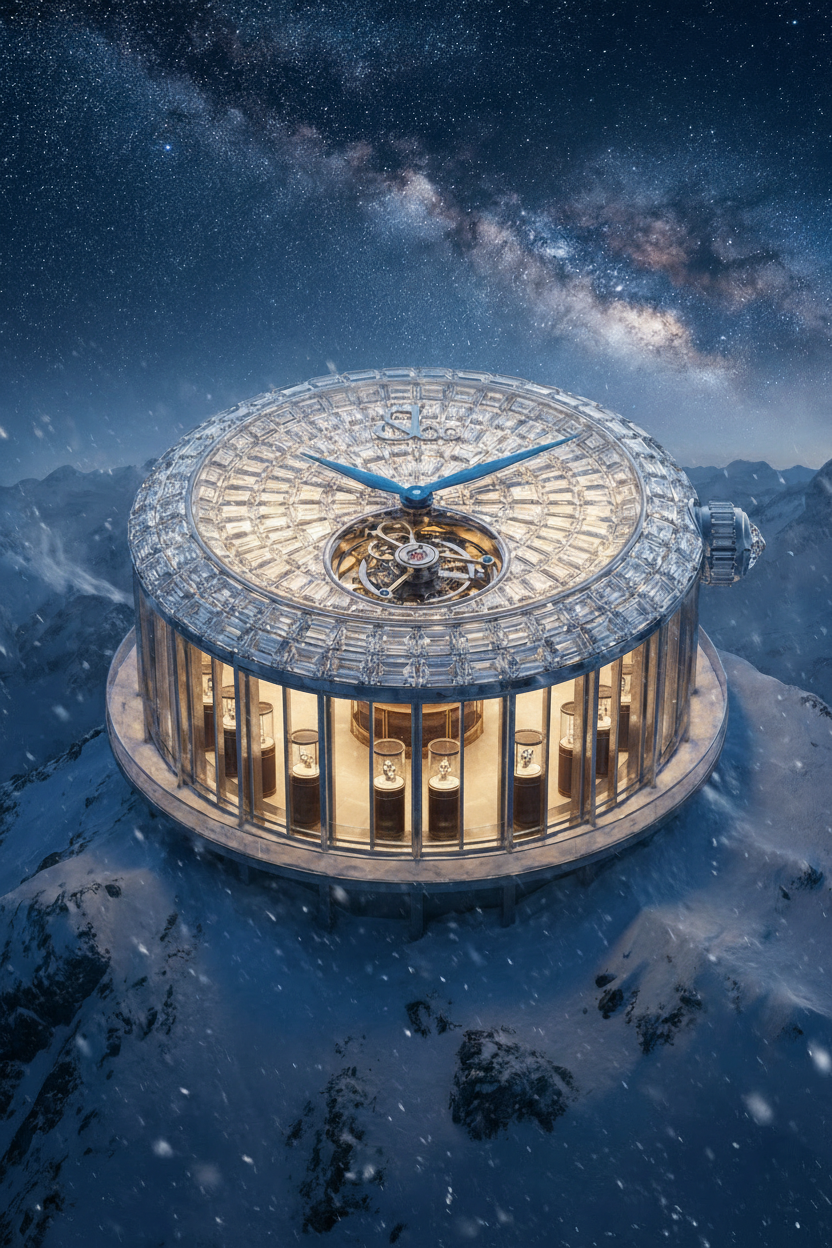
Environments were generated quickly and with consistent quality: snow under winter light, intimate interiors with wood paneling, golden reflections on marble surfaces. AI excels at this type of atmospheric rendering, especially when you constrain the color palette and lighting via reference images.
The generated characters also worked well. We created three profiles (two women, one man) by fixing facial features, skin tone, and hairstyle from the first iteration, then reinjecting these references into each scene. Visual consistency across shots was maintained without major difficulty.
Vertical (9:16) and square (1:1) formats were generated in parallel, with adapted framing: close-ups on the hand wearing the ring, medium shots for watches on the wrist. No need for post-production cropping, everything is planned from generation.
The difficulties: reflections and jewelry details
The real technical challenge, the one that required the most time, was jewelry fidelity. Generative AI doesn't "understand" material physics: it imitates what it has seen in its training data. Result: reflections on a watch's sapphire crystal, the facets of a diamond, engravings on a case—all of this can be approximate or inconsistent from one image to another.
Concretely, across a series of three shots of the same watch, we observed:
- Subtle variations in the position of dial indices.
- Reflections that didn't respect the scene's light source.
- Loss of sharpness on fine details (engravings, logo) despite high resolution.
We corrected these points in post-production, reinjecting elements of the original jewelry via masking and blending. This isn't cheating: it's the same logic as classic product retouching, where you ensure the final visual is faithful to the real piece. But it lengthens the workflow and requires an expert eye to identify what needs to be redone.
Another blocking point: hands. Generation after generation, fingers, nails, proportions posed problems. We ended up generating hands separately, in close-up, then integrating them into the final scenes. Less elegant technically, but more reliable.
Post-production: retouching, consistency, delivery
Between D9 and D12, we scrutinized each asset. Every image delivered to a luxury client must be flawless: no blur on the product, no inconsistency in reflections, no detail that betrays approximate generation.
We used a combination of classic retouching (Photoshop, masks, color corrections) and targeted regeneration (inpainting on problem areas). Each piece of jewelry was verified against product photos provided by Jacob & Co. Reflections were adjusted to match the light direction. Skin textures, hair, clothing folds were refined to avoid the "too smooth" effect that often betrays AI.
The client received a first batch of 25 visuals on D12. Two minor notes: a color adjustment on one setting (too cold), and a request for a ring variant (slightly different angle). Revisions delivered on D13, final validation on D14.
The full project detail is told in this article, which also addresses the strategic and creative challenges of the collaboration.
What we'd do differently
Looking back, three things could have been optimized.
First, the preparation of jewelry references. We should have requested very high-resolution product photos, from multiple angles, from D0. This would have reduced the number of generation iterations and simplified post-production. On a future project, we'd also integrate 3D renders if the brand has them: it's the best way to guarantee product fidelity.
Second, hand management. Rather than generating complete scenes then correcting, we should have composed from the start: hands generated separately, integrated afterward. Less "pure" in terms of AI workflow, but more efficient. High-end AI production is often hybrid, and that's a strength, not a limitation.
Finally, intermediate validation. We showed a first preview on D8, but a checkpoint on D4 would have allowed us to validate the art direction earlier and avoid some unnecessary iterations. On a 14-day deadline, every day counts.
What this Jacob & Co AI campaign taught us
This AI campaign case study confirms what we observe across all our luxury projects: AI enables unprecedented velocity, but final quality rests on art direction, technical rigor, and the ability to correct what doesn't work. Generating 400 images in a few days has value only if you know how to select 25 flawless ones.
Jewelry remains one of the most complex challenges in image generation: reflective materials, micrometric details, high client expectations. Each campaign teaches us to better constrain generation, anticipate friction points, hybridize techniques. That's what makes the difference between a generated image and a delivered campaign.
Jacob & Co obtained a cohesive, high-end Holiday 2025 campaign, usable across all their channels, in a timeline incompatible with traditional production. We delivered in 14 days what would have required several weeks of casting, shooting, post-production. But this time saving didn't come at the expense of quality: it required precise creative framing, sharp technical expertise, and constant adaptability.
FAQ
Can you really guarantee the fidelity of a jewelry piece with AI?
Yes, provided you combine generation and retouching. AI alone can approximate, but by reinjecting product references in post-production, you ensure total fidelity. It's the same logic as classic product retouching. The right reflex: provide high-resolution photos from the start of the project.
Why 400 images generated for 25 delivered?
Because in luxury production, we only deliver what is flawless. Each image must respect artistic consistency, product fidelity, and client standards. AI generation is fast, but selection and post-production remain demanding. This ratio is normal for this type of project.
How long does a similar campaign take?
One week is possible if the brief is locked down from D0 and product references are provided immediately. Fourteen days allow for integrating revisions and refining post-production. Everything depends on the number of assets, product complexity, and the desired level of retouching. Ask your agency for a detailed timeline before launching.